Friday, 8 April 2016

Sausage Rolls


Warning  -  these are very moreish and you cannot eat just one....

1 pack of sausage meat (about 500g)
1 pack fresh or frozen puff pastry (in sheet form rather than brick form - it's quicker)
1 tsp Pataks madras spice paste 
1 small finely chopped onion

Fry the onion gently in some sunflower oil, adding the Pataks towards the end. The onion should be soft and slightly caramelized. Leave aside to cool.
Put the sausage meat in a bowl and add the cooled onion mixture, giving it a good mix to distribute it evenly through the sausage.
Unroll the sheet of pastry and cut it in half lengthwise to make two rectangles about 25 by 15 cm
Place a roughly log shaped piece of sausage meat all the way along the rectangle, just slightly off centre (it will probably not want to form a nice neat log, but it doesn't really matter). Try to get it as evenly spread as possible.

Brush the pastry edge with  a little water.Fold the pastry over to make a long roll, sealing the long edge by pinching it all along the edge. Crimp with a knife handle to make it look fancier if you want.
Brush the roll with beaten egg, sprinkle with sesame seeds if you like, then cut the roll into 2cm pieces.
Place them well apart on a baking tray and bake them for about 20 minutes in a hot oven (190 - 200C) until golden brown.
Try not to burn your mouth when you can't wait to try the first one as soon as it comes out the oven.


Tom's Pork Belly Fajitas


Tom is back from university for the Easter holidays and offered to cook. He wanted to try to recreate a Mexican dish he'd eaten in Toronto at La Carnita; a pork dish with flavours of chili and some sweetness.  Not ever having eaten in La Carnita (but wishing I had) I can't confirm if it is like its inspiration, but it was utterly delicious and I could have eaten the whole lot by myself.

slices of pork belly (about 150g per person), salted and peppered and seared in a large pan.
Add chopped onions, jalapeno peppers and some garlic to the pan.
Then add dried oregano, cumin, smoked paprika and a bay leaf and pour Corona beer over the top until the pork is submerged. Add a dollop of honey and a splash of cider vinegar.
Cover and simmer for two hours by which time the pork will be tender and falling apart. Uncover towards the end of cooking to reduce the sauce.
Remove the pork from the sauce and pull/chop the pork into pieces. spoon the fat off the sauce and boil to reduce it to a thick consistency then pour over the pork.
Serve with warmed soft tortillas or crispy tacos, salsa, guacamole, sour cream, lettuce, fried green and red peppers, grated cheese, refried beans and fresh coriander - diners assemble their own according to taste.

Monday, 21 March 2016

Carnabara Pie (baked spaghetti, cheese and bacon)


450g spaghetti 
1 small onion, finely chopped 
2 cloves garlic, minced
1 tsp dried oregano 
150g cooking bacon, finely cubed
6 medium eggs, beaten 
1 cup full cream milk 
1 cup single cream
Plenty of freshly ground black pepper 
225g grated cheese (mixture of pecorino, cheddar or whatever you have and like)

Part cook the pasta for about 5 minutes in boiling salted water, but make sure it is still quite firm as it will continue to cook in the oven. Drain and leave to cool.
Gently fry the bacon, oregano and onion in a little olive oil until soft and slightly browned. Leave to cool.
Line a deep round glass oven dish with grease proof paper.
Beat the eggs, milk and cream together, then stir in the bacon mixture and season with plenty of black pepper. Stir in about three quarters of the cheese, then stir in the spaghetti and mix well to coat it all with the eggy sauce.
Pile the whole lot into the prepared dish and bake for about half an hour, or until set and golden. If it starts to brown too quickly cover with foil. Leave to rest for a few minutes then serve in large slices with green veg or salad and garlic bread.


Sunday, 31 January 2016

Salmon with Thai spiced cashew nut coconut topping


This was a lucky experiment that turned out to be delicious and very easy - not always the case, but this one will definitely join the regular repertoire. I served it with coconut rice and some broccoli and green beans. 
Update: I made this last week, thinking I had cashew nuts in the cupboard. I didn't, s I used a mixture of almonds and pistachios, which was just as good as the original recipe.

For 6 people

6 salmon fillets (about 150g each)
80g cashew nuts (unsalted)
1 thickish slice wholemeal bread 
2 spring onions, trimmed and roughly chopped
1 tsp Thai green curry paste  (I used Mae Ploy brand, which is quite spicy and strong; a little goes a long way and the dish had the perfect level of spice, you may need to use a bit more of other brands).
a good dollop, maybe 1 tbsp,of coconut milk (use a bit from the can you use for the rice)
dash sesame oil
small bunch of fresh coriander, washed
2 tbsp unsweetened desiccated coconut 

Preheat the oven to 190 C (fan).

Blitz all the ingredients apart from the salmon in a food processor until it forms a chunky paste (not too smooth, you still want some texture in the nuts).

Put the salmon fillets in one layer in an ovenproof dish and spread the topping over them evenly.
(As I'd made some summer rolls as a starter, I had a few bits of red and green pepper, carrot and spring onion left over, which I finely chopped and scattered over the salmon before baking it. I'm not sure whether it made much difference, but I didn't want to waste the veggies! Some finely sliced pieces of red pepper laid across the salmon would probably work well, but it would be fine without.)

Bake for about 15 minutes (until you see the juices start to run out of the salmon).
That's it!

Coconut Rice

Serves 6

1 tsp butter
good dash (about 1 tbsp)  sunflower oil
1 small red onion, finely chopped
375g basmati rice
1 can coconut milk
1 bay leaf
salt

Soak the rice for 15 minutes in cold water, then rinse and drain in a sieve. Heat the butter and oil and saute the onion gently until softened but not too browned. Stir in the rice and coconut milk. Fill the coconut milk can with water and tip that into the rice too. Add the bayleaf and a little salt. Give it a good stir, cover and bring to the boil and simmer for about 15 minutes, stirring occasionally, until the liquid is absorbed and the rice is cooked. If the liquid absorbs too quickly, before the rice has cooked, add a couple of splashes of boiling water as it cooks.

This went really well with the salmon with Thai spiced cashew and coconut topping.

Thursday, 21 January 2016

Cassoulet (kind of)


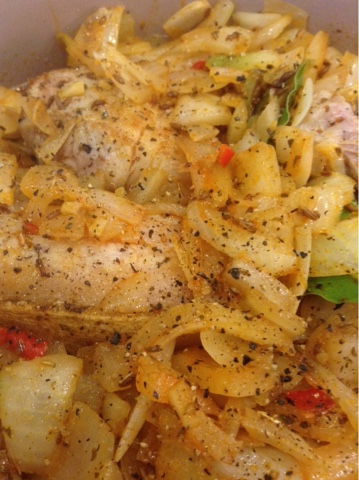
Not what a purist would call a cassoulet, but this is a rich and tasty one pot casserole perfect for cold winter evenings. Serve with chunks of bread, and maybe some steamed green beans. 

500g chicken thighs
2 large leeks
1 large courgette 
1 large red or yellow pepper
4 cloves garlic
shake of dried mixed herbs
2 or 3 fresh thyme sprigs
2 fresh bay leaves
about 500ml chicken stock
Good dash or two of white wine
3 or 4 sundried tomatoes (in oil) chopped
A few chunks of cooked antipasto peppers (in oil)
250g cooking chorizo
150 g cooking bacon 
500g small potatoes, skin left on, halved if necessary to make chunks a couple of centimetres across
pepper
Optional chunks of sweet potato and carrot, depending on what is lurking in the cupboard.
dash of smoked paprika
2 cans cooked butter beans or other cooked beans drained.


  1. Cut most of the skin off the chicken thighs and discard (I tried leaving it on and frying it, but it didn't really work - I had to pour off a lot of fat and the skin was quite unappetizing at the end of the cooking time).
  2. Wash and slice the leeks into 1cm discs.
  3. Peel and chop the garlic finely
  4. Wash and chop the red pepper and courgette into chunks.
  5. Cut the chorizo into chunks.
  6. Brown the chicken thighs in some olive oil (use the oil from the jars of sundried tomatoes or peppers) in a deep oven proof dish/Dutch oven. Transfer to a plate. You can also use boned thighs, chopped into large pieces and browned. In that case you don't need to remove them from the pan, just toss everything together.
  7. Toss the bacon, peppers and leeks in the pan used for the chicken, then add the mixed herbs and garlic and fry gently for about 3 minutes.
  8. Put back the chicken thighs, then add all the other ingredients except the butter beans. Season with pepper (it will probably be salty enough from the chorizo and bacon).
  9. Give it a good stir and bring to the boil, then put the lid on and transfer to the oven on about 160 C for a couple of hours or so, stirring occasionally and stirring in the butter beans about half an hour before serving.


Sunday, 13 December 2015

Mince Pies


The classic mince pie. Can't be beaten. Serve warm; prize off the lid, top with a dollop of clotted cream, replace the lid and prepare for deliciousness.

For 12 - 15 mince pies

8 oz plain flour
pinch salt
2 oz white vegetable fat (eg Trex), cut into 2 cm cubes
2 oz butter cut into 2 cm cubes
2 - 3 tbsp very cold water
a jar of mincemeat
a splash of milk
sprinkling of sugar


  • To make the pastry, put the flour,salt, butter and vegetable fat into a stand mixer bowl. Mix with the 'k' beater until the mixture resembles breadcrumbs - it doesn't mater if there are still a few small lumps of butter. This can also be done in a food processor (beware of overmixing, it mixes very quickly).
  • Add two tablespoons of the cold water and mix slowly until the mixture begins to clump together and a dough begins to form. If it still looks dry, add another half a spoon of water and mix some more; don't be tempted to put too much water in at a time. At this stage it is important not to work the dough too much, or it will become tough (this is all to do with the amount of gluten that forms in the dough if you overwork it, or if you add too much water- you don't want pastry dough to be made too elastic by the gluten, so you work it as little as possible). As soon as you have clumps of mixture stop mixing and try gently squishing the clumps together with your fingers. If a dough forms without flakes coming off, it's ready and you can tip it onto a work surface and gently squish it all together to form a ball of dough. 
  • If you're not in too much of a rush, wrap the dough in cling film and put it in the fridge for 15 minutes. Apparently this makes it easier to roll out. I often am in too much of a rush, so I roll it straight away. Putting it in the fridge to rest is supposed to allow the gluten time to relax, but I'm blowed if the gluten is going to get to relax if I don't!
  • Flour the surface lightly, flour the rolling pin and roll the dough to thickness of about 4mm. Using pastry cutters, cut out 12 circles big enough for your bases and 12 smaller circles for the lids  (a regular mince pie tin needs bases about 7cm diameter and lids about 5.5cm). You will need to squish the dough trimmings back together and re-roll to get the full number. I have read that you shouldn't re-roll the trimmings more than a couple of times, to avoid tough pastry, but I just keep going until I've used up all the pastry, normally ending up with 15 pies for this amount of pastry.
  • Preheat the oven to 180 C
  • Lay the bases in the mince pie tin, put in about 1 tsp of mincemeat (I always use the mincemeat as it comes from the jar, although you can make your own, or add extras like chopped apple and brandy to the jar).
  • Top with the lids, very gently pressing them onto the bases. (Because we serve the hot pies with clotted cream, we like to prize off the lids and put the cream inside, so you don't want the lids too stuck down. You can always just dollop the cream on top of the cooked pie if you prefer.)
  • With the tip of a sharp knife make a couple of little slits in the top of each pie, then brush them with a little milk and sprinkle with granulated sugar.
  • Bake in the hot oven for about 15 minutes, then transfer to a cooling rack. If you want you can give them a dusting of icing sugar before serving.
  • Serve with proper Cornish or Devon clotted cream, although I believe some people like them with brandy butter or single cream.


Please don't eat me!